

Reputation+



Most brands treat paid and organic social like two separate departments. The paid team chases ROAS. The organic team chases engagement. They share the same profiles but rarely the same strategy. That is a costly mistake, and it leaves significant growth on the table.
The most effective social media advertising strategy does not choose between paid and organic. It uses each to make the other stronger. Ads reach people who have not found you yet. Organic content gives them a reason to stay. Community turns that audience into something that compounds over time.
This guide breaks down exactly how to do that, with frameworks you can put into practice today.
|
Table of contents |
What is social media advertising, and why does it need a community strategy?
Social media advertising refers to paid placements across platforms like Meta, TikTok, LinkedIn, Pinterest, and X, including sponsored posts, Stories ads, video campaigns, and boosted content. Unlike organic content, social media ads are targeted, paid for, and distributed beyond your existing followers.
But here is the thing most paid social playbooks miss: the ad is not the end of the experience. It is the beginning.
When someone clicks on your ad or sees it in their feed, they often check your profile next. They read your comments. They look at how you respond to people. They judge whether your brand is worth following and whether you are worth buying from.
That means your paid and organic social presence are permanently intertwined. You cannot invest heavily in advertising on social media and neglect the community side. If you do, your ads will drive traffic to a ghost town, and your cost per acquisition will reflect that.
The false dichotomy between paid and organic social
Here is a common framing you will see in marketing discussions: "Should we focus on paid or organic?"
It is the wrong question.
Paid and organic social serve different functions in the customer journey, and those functions are complementary, not competitive.
| Paid Social | Organic Social | |
| Primary function | Reach and acquisition | Relationship and retention |
| Audience | New or retargeted | Existing followers and community |
| Control | High (targeting, creative, timing) | Medium |
| Trust signal | Lower (clearly an ad) | Higher (feels authentic) |
| Compounding effect | Low (stops when budget stops) | High (content and community grow over time) |
| Best for | Driving discovery | Deepening loyalty |
The brands winning at social are not picking a lane. They are using paid social media to seed new communities and organic content to nurture them. Ads bring people in. Community makes them want to stay.
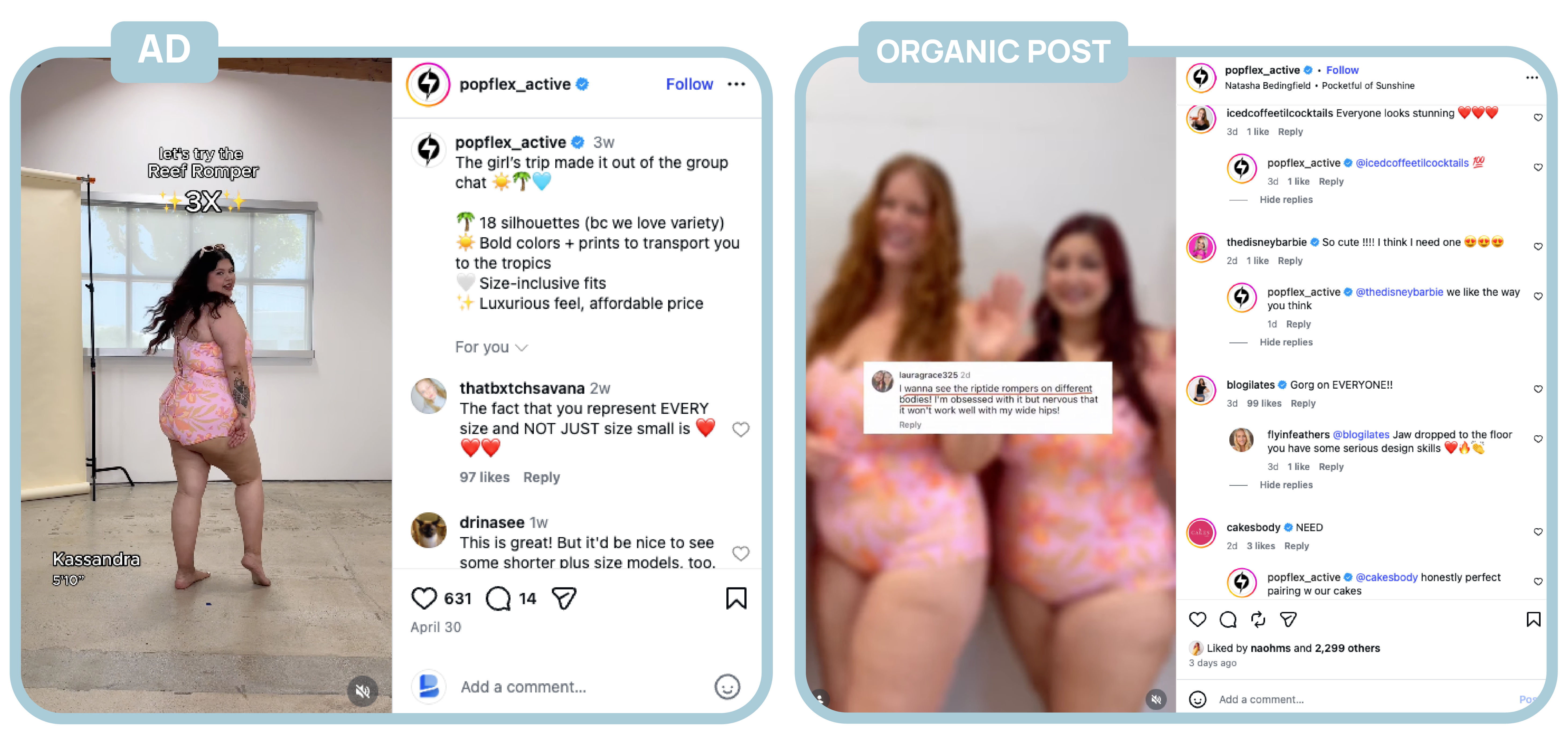
Popflex treats every comment as a content brief. A follower asking if the romper works for wide hips on organic, a size-inclusivity comment racking up 97 likes on the ad — all of it feeds back into their strategy. That is what active community listening looks like, and it is why their paid and organic content feel like two parts of the same conversation.
How social media ads can build community (not just drive conversions)
Most advertisers optimize social media ads for clicks, leads, or purchases. These are valid goals. But there is an underused application of paid social that compounds in value over time: using ads to recruit community members, not just customers.
This reframe changes which campaigns you run, how you measure them, and what success looks like.
1. Use ads to surface your best organic content
Your most engaging organic posts, the ones that sparked real conversation, debate, or emotion, are your best community recruitment tools. Boosting them exposes new audiences to your brand at its most authentic. Instead of crafting polished ad copy, you are showing what it actually looks like to be part of your community.
This approach also creates a useful feedback loop: the comments and reactions on boosted organic posts tell you exactly what resonates before you invest in heavier creative production.
2. Target lookalike audiences based on your most engaged followers
Platforms like Meta allow you to build custom audiences from people who have engaged with your content through commenting, sharing, and saving. These are higher-intent signals than simple page likes or video views.
When you build lookalike audiences from engaged community members rather than purchasers, you are finding people who are likely to participate in your community, not just buy once and leave. That is a fundamentally different (and often more valuable) audience to acquire.
3. Run "community-first" campaign objectives
Not every campaign needs to be a conversion campaign. Consider running awareness and engagement campaigns explicitly designed to:
- Grow your follower base with people who match your community profile
- Drive saves and shares, which are strong signals of high content value
- Generate comments and conversation around a specific topic
- Build video view audiences you can retarget later with deeper content
These softer KPIs look worse on a ROAS dashboard. But they build the foundation that makes every future ad cheaper to run.
Maintaining an authentic brand voice in paid social
One of the fastest ways to erode community trust is running ads that feel nothing like your organic content. If your social feed is warm and conversational but your ads are stiff and salesy, people notice the disconnect, and it reads as inauthentic.
Authenticity is not a soft concept. Research consistently shows that consumers factor it heavily into purchasing decisions. In a landscape where people are scrolling past hundreds of ads daily, content that feels real performs better.
Here is a practical framework for keeping your brand voice consistent across paid and organic content.
The brand voice bridge framework
-
Step 1: Document your organic voice before writing a single ad. Pull your 10 most-engaged organic posts. What words and emojis appear repeatedly? What sentence rhythm do you use? Is your brand funny, direct, empathetic, or expert? Write this down explicitly, not vaguely ("we are friendly") but specifically ("we use first-person, short sentences, and ask questions at the end of posts").
-
Step 2: Apply the "would we post this organically?" test. Before publishing any ad, ask: if this were not paid, would it fit in our organic feed? If the answer is no, revise until it does. This does not mean ads cannot have CTAs, but the personality around the CTA should be consistent with who you are.
-
Step 3: Use your community's own language. Read your comments. See how your audience describes their problems, their wins, the things they care about. Mirror that language back in your ads. This creates immediate resonance and signals that you actually understand your audience because you have been listening to them.
-
Step 4: Moderate and respond to ad comments at the same standard as organic. Comments on your ads are part of your community. Ignoring them, or leaving spam and negativity unaddressed, signals that the "community" your organic content promises is not real when money is involved. The brands that win on paid social respond to comments on their ads with the same care they give their organic content.
Building a paid + organic integration strategy
Here is how to practically structure your social media advertising strategy so paid and organic work together rather than running in parallel silos.
Phase 1: Organic Foundation (Weeks 1 to 4)
Before scaling paid social, establish what you are inviting people into. This means:
-
Defining your content pillars, which are the 3 to 5 topics your brand consistently owns
-
Building a backlog of content that demonstrates your community values
-
Setting up response protocols so incoming engagement is handled consistently
-
Identifying your top 5 to 10 performing organic posts as future paid candidates
Phase 2: Paid Amplification (Weeks 5 to 8)
Once the organic foundation is solid, introduce paid with a community lens:
-
Boost your best-performing organic content to cold audiences rather than only running standalone ads
-
Run follower acquisition campaigns to audiences who look like your most engaged followers
-
Use engagement campaigns to seed comments and social proof on posts before broader distribution
-
Retarget video viewers with content that deepens the relationship rather than immediately pushing for a sale
Phase 3: Community Conversion (Weeks 9 to 12)
Now use your warmed community for conversion campaigns:
-
Retarget people who engaged with your boosted organic content
-
Use testimonials and community-generated content in conversion ads, which dramatically increases trust
-
Deploy remarketing to followers who have not purchased, using content that addresses common objections
-
A/B test community-voice creative against traditional ad creative to quantify the performance gap
Phase 4: Continuous Optimization
Treat the organic and paid loop as perpetual:
-
Mine ad comments for content ideas by tracking which questions, objections, and enthusiasms come up repeatedly
-
Feed high-performing paid creative back into your organic calendar. If an ad is resonating, post it organically too
-
Use paid social data to inform your organic strategy. What messaging drove cheap CPCs? That is what your audience cares about
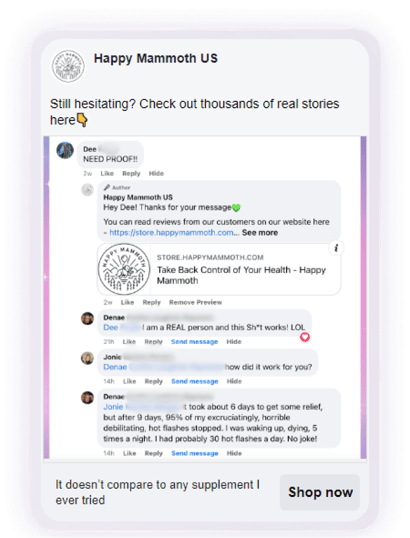 Happy Mammoth turned their ad comment section into a word-of-mouth machine.
Measuring success beyond ROAS
ROAS (return on ad spend) is a legitimate metric, but as the sole measure of a social media advertising strategy, it is incomplete. It captures short-term transactional value and misses the compounding value of community.
Here is a more complete measurement framework.
Tier 1: Community Health Metrics
These tell you whether your community is growing in quality, not just size.
- Engagement rate on organic content. Is it growing alongside your paid spend? A rising ad budget with flat organic engagement is a warning sign.
- Comment sentiment. Are comments positive, neutral, or negative? Tools like BrandBastion's AI-powered sentiment analysis can track this at scale across both paid and organic posts.
- Response rate and speed. Are you maintaining community relationships even as volume grows?
- Follower growth rate. Are ads actually building your audience, or just driving clicks that never convert to followers?
Tier 2: Paid-to-Community Conversion Metrics
These tell you whether your ads are building real community members.
- New follower rate from paid campaigns. What percentage of ad viewers follow your account?
- Engagement rate on boosted posts. Are cold audiences actually engaging, or just scrolling past?
- Saved posts from paid content. Saves indicate high-value content worth returning to.
- Return visitor rate to profile. Are ad-driven visitors coming back to your page organically?
Tier 3: Commercial Metrics
These should be measured, but in context.
- ROAS by campaign type. Expect conversion campaigns to show higher ROAS. Community-building campaigns should be evaluated on different terms.
- Customer lifetime value (LTV) by acquisition source. Customers acquired through community-first funnels often show higher LTV. This is the data that justifies the investment.
- Cost per engaged user vs. cost per click. An engaged user who commented, saved, or followed is worth far more than a passive click.
Common mistakes to avoid
Running paid and organic as separate teams with no shared feedback loop. If your paid team and community team do not talk, you will end up with brand voice inconsistencies, missed retargeting opportunities, and data sitting in silos where it cannot compound.
🛒 Using ads only for bottom-of-funnel conversion. If every ad you run is a conversion ad, you are burning budget on cold audiences who have not been warmed up. Build the community funnel before asking for the sale.
💬 Ignoring comments on paid posts. Ad comments are one of the highest-visibility places for community management. Negative or unanswered comments on ads are seen by huge audiences. Positive responses are equally visible and equally powerful.
💬 Measuring only ROAS and making budget decisions based on it. A community-building campaign targeting new potential followers will never beat a retargeting campaign on ROAS. That does not mean it is failing. It means you need tiered measurement.
📉 Boosting content that was not strong organically. If something did not resonate with your existing audience, paid distribution will not fix it. Only boost content that has already earned engagement.
Quick-reference: paid vs. organic decision guide
Use organic content to:
- Deepen relationships with existing followers
- Test messaging and creative before paying to amplify
- Demonstrate your brand's values and personality over time
- Build the kind of social proof through comments and shares that makes ads perform better
Use paid social to:
- Reach new audiences who match your community profile
- Amplify your best organic content beyond existing followers
- Retarget warm audiences with deeper content or conversion offers
- Accelerate community growth during key product launches or moments
Use both together to:
- Build a community that compounds in value over time
- Reduce your long-term cost of acquisition
- Create brand advocates who generate organic word-of-mouth
- Make every future campaign perform better because your audience already trusts you
The bottom line
Social media advertising and community building are not competing priorities. They are two sides of the same strategy. Ads bring new people into your orbit. Community gives them a reason to stay. The brands that understand this are not just running better campaigns. They are building assets that compound in value over time.
The shift starts with a simple reframe: your next ad campaign is not just a revenue driver. It is an invitation to join something.
Build a community worth joining first. Then use paid social to make sure the right people see it.