

Reputation+



Managing social media as a direct-to-consumer brand involves a lot more than publishing content on a schedule. The brands growing fastest on social are winning in the places most teams ignore: the comment sections of their paid ads, the DMs that never get answered, the influencer partnerships that generate content but never get amplified properly, and the brand conversations happening across platforms that nobody is tracking.
This guide focuses on what great DTC social media management actually requires, and which tools lead in each of those areas.
What DTC social media management actually requires
Most DTC brands think about social media management primarily as a publishing problem: how do we get content out consistently, across the right channels, at the right time? That's a real need, and there are plenty of tools that solve it well. But publishing is the easiest part of the job.
The harder, higher-stakes work is everything that happens after the content goes live. Comment sections fill up fast, especially on paid ads running at scale. Brand mentions appear across platforms with no central place to track them. Influencer content gets created but sits underutilized. Customer questions go unanswered. Harmful or spammy comments erode the social proof your creative spent to build.
According to HubSpot research, 90% of customers expect quick responses on social media. For DTC brands, slow or absent responses don't just frustrate customers; they suppress conversions and hurt the performance of live campaigns.
Effective DTC social media management covers five areas: moderation, engagement, influencer content amplification, social listening, and analytics. Most generic social media tools handle one or two of these adequately. The challenge is finding a stack that covers all of them without requiring five separate platforms.
Moderation: protecting your brand at scale
Comment moderation is where DTC brands lose the most value without realizing it. Every paid social campaign is generating a live, public conversation. Left unmanaged, that conversation becomes a place where competitors drop links, spam bots flood the thread, unhappy customers go unanswered, and would-be buyers get put off before they ever click through.
The most capable tool for this at the DTC level is BrandBastion, which monitors and moderates paid and organic comments, DMs, and brand mentions across all platforms and in 194 languages. It uses AI-powered automation with brand-specific models, sensitivity levels, and comment categories so moderation adapts to post context and can be customized. You control what gets hidden by platform, campaign, or post type, while real-time alerts and AI summaries help your team spot emerging risks fast.
Key moderation capabilities to look for in any tool:
- Real-time removal of spam, competitor mentions, hate speech, and harmful comments
- Customizable rules by campaign, post type, language, and keyword
- Crisis detection with early alert notifications
- Multi-language moderation

"Before BrandBastion, tracking conversations on social media and agent activity was a huge challenge. BrandBastion has been a game-changer for us. We've saved over 450 hours monthly in moderation and in responding efforts."

Engagement: turning conversations into conversions
Moderation keeps the harmful content out. Engagement is what builds the conversation worth having. For DTC brands, the comment section is one of the most visible customer touchpoints available: public, persistent, and seen by everyone considering a purchase at that moment.
The challenge is volume. A brand running several paid campaigns simultaneously across Meta and TikTok can generate hundreds or thousands of comments per day. Without a centralized system, most of those interactions go unaddressed.
BrandBastion consolidates comments, DMs, and brand mentions from all connected platforms into a single inbox, with pre-drafted AI reply suggestions that are tailored to each post's context, pull from your knowledge (website, help center, product pages...), and follow your brand's voice guidelines. Teams can respond faster without sacrificing consistency, and priority flagging surfaces the comments most likely to influence a purchase decision.
For teams evaluating options in this space, the key questions are whether the tool can handle cross-platform volume in one place, whether responses can be accurate and customized to your brand voice, and whether it integrates with moderation.
Key engagement capabilities:
- Unified inbox for comments, DMs, and mentions across platforms
- Pre-drafted accurate replies tuned to post context and brand voice
- Replies grounded in your website and help center
- Priority flagging for purchase-intent and high-value interactions

“Before BrandBastion, we had to toggle between Gorgias and Sprout Social to make sure all comments, DMs and reviews were being answered”

Influencer partnerships and collab posts
This is where most DTC social media management tools fall short entirely. Brands invest significantly in influencer partnerships but often lack the infrastructure to manage and amplify that content at scale once it exists.
Whitelisted ads (also called partnership ads or allowlisted ads) allow a DTC brand to run paid advertising through an influencer's account rather than its own. The ad appears under the influencer's handle, with all the social trust and authenticity that carries, while the brand retains full control over targeting, budget, creative testing, and optimization. CTR and conversion rates on whitelisted ads frequently outperform standard brand ads precisely because the content reads as an authentic creator recommendation rather than a brand promotion.
Collab posts on Instagram allow two accounts to co-author a single post that appears on both profiles simultaneously, extending organic reach to both audiences without additional spend.
What's often overlooked is that both formats still generate comments at the same volume as any other paid or organic post, and those comment sections still need to be actively managed. When a whitelisted ad runs under an influencer's handle, the social trust it carries is precisely what makes it perform well. Letting that comment section fill with spam or negativity undermines the format's core advantage.
BrandBastion extends its moderation and engagement coverage to whitelisted ads and collab posts, meaning the same workflows that protect brand-owned content also apply to creator-run ads. For DTC brands running active influencer programs alongside paid social, this integration removes a significant gap in most tool stacks.
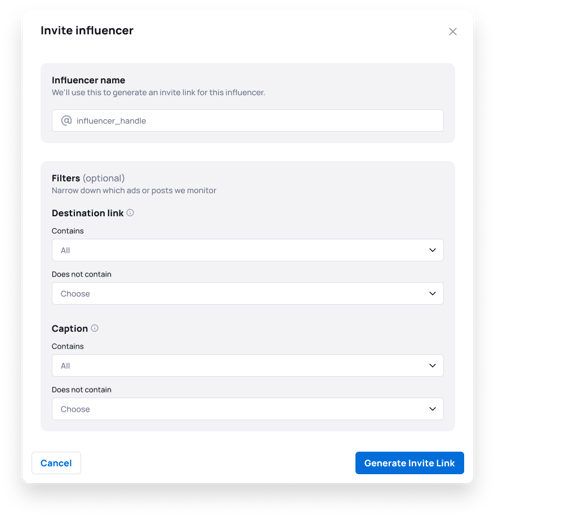 BrandBastion's invite links let influencers securely connect their Meta assets so you can monitor partnership ad comments without adding them to your owned asset stack.
Social listening and sentiment analysis
Most DTC brands only track conversations where they’re tagged directly. That leaves a significant amount of useful information unmonitored: mentions without tags, conversations around competitor products, and sentiment shifts that often precede changes in purchase behavior or a wave of customer complaints.
Good social listening for DTC brands means tracking brand mentions across platforms in real time, understanding how sentiment is shifting over time, and surfacing that intelligence in a way the team can actually act on rather than export to a spreadsheet once a month.
BrandBastion integrates listening and brand sentiment analysis into the same platform used for moderation and engagement, which has a practical advantage: the team managing community health is also seeing the signals that should inform content strategy and campaign decisions, without switching tools. Also, BrandBastion sentiment analysis uses your brand context and business goals to classify sentiment based on real impact. Powered by Astra, our AI Analyst, teams can extract actionable insights from their social media interactions, from improving product feedback loops and managing crises to planning the next ad campaigns.
For brands that need broader web listening beyond social platforms, tools like Brandwatch, Meltwater, and Semrush offer wider keyword, topic, and media monitoring across sources such as news, blogs, forums, review sites, and podcasts. These tools can work well as a complement for brands whose category conversations happen significantly outside of social, while BrandBastion remains the better fit for teams that want listening, sentiment analysis, moderation, and engagement connected directly to their social media workflows.
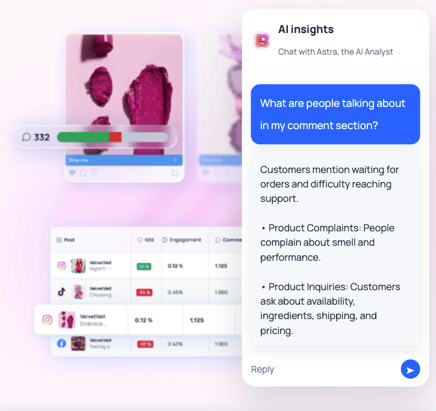 BrandBastion's Astra, the AI Analysist
Analytics and performance tracking
Social media analytics for DTC brands are most valuable when they connect community activity to business outcomes rather than stopping at reach and follower counts.
BrandBastion's reporting connects engagement and sentiment data directly to ad performance, which makes it possible to see how comment health correlates with ROAS, how response time affects conversion rate, and where community quality is highest across campaigns. For DTC teams trying to make the case internally that community management affects revenue, this kind of reporting is more useful than standard social analytics.
For broader cross-platform social reporting, Sprout Social is a solid option. It surfaces engagement rates, link clicks, and platform-level performance across channels in a format that works well for leadership reporting and strategic planning.
Native platforms still matter too. Meta Ads Manager and TikTok Ads Manager remain essential for campaign-level optimization, while GA4 and Shopify Analytics provide important website, conversion, and commerce data. TikTok’s reporting, for example, is built for organizing campaign data into tables and charts, while Shopify provides commerce-focused reporting on store performance.
The most effective setup is usually a layered one: native ad platforms for in-platform optimization, ecommerce analytics tools for attribution and profitability, and a tool like BrandBastion for understanding how community quality, sentiment, and engagement are influencing performance over time.
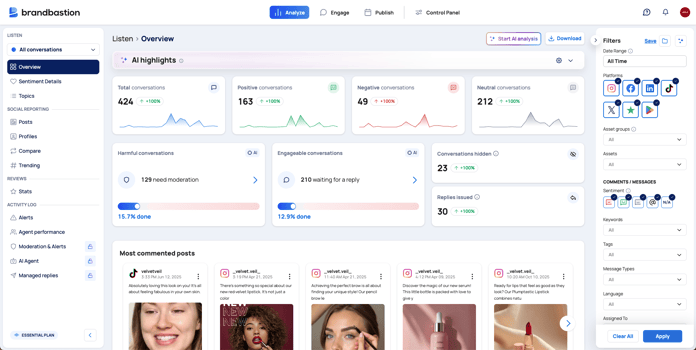 BrandBastion's Platform Overview
Scheduling and content creation tools
Content scheduling and team collaboration or approval are a solved problem with several good options depending on team size and workflow.
Buffer is clean, simple, and cost-effective for teams that publish consistently without needing enterprise-level features. Its free tier covers three channels, which is enough for early-stage brands, and the paid plan adds analytics and removes posting limits.
Later is worth adding for visual-first DTC brands, especially those that rely heavily on Instagram, TikTok, Pinterest, and creator-style content. Its strengths are content calendar planning, social scheduling, and Linkin.bio, which helps brands connect social content to product discovery and traffic. This makes it a strong fit for teams that care about how the feed looks, how campaigns are sequenced, and how social posts support commerce.
Hootsuite suits higher-volume teams better, with built-in AI copy assistance through OwlyWriter and stronger team collaboration features. It works well when multiple people are managing a shared content calendar across several platforms simultaneously.
For content creation, Canva covers in-house production for brands without a dedicated designer. Magic Studio tools (AI background expansion, Magic Write for copy, Magic Design) let a social media manager turn a product image into a set of platform-ready assets quickly.
For teams managing large libraries of UGC, influencer content, and campaign assets across multiple channels, a dedicated digital asset manager like Dash keeps visual content searchable, organized, and easier to share across the team.
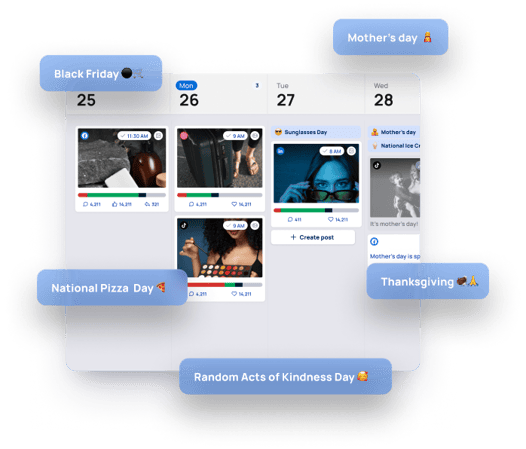 BrandBastion's Publish feature
Building your DTC social media management stack
Early-stage DTC brand:
- Buffer for simple, cost-effective scheduling
- Canva for content creation
- Later for visual content planning and scheduling, especially if Instagram, TikTok, and Pinterest are key channels
- Native platform analytics for campaign-level performance
Scaling DTC brand:
- BrandBastion for real-time moderation, engagement, influencer content coverage, listening, sentiment analysis, and community-performance insights
- Later, Buffer, or Hootsuite for more publishing capabilities, depending on whether the team prioritizes visual planning, simplicity, or larger-team collaboration
- Dash for asset management across campaigns, UGC, and influencer content
- Semrush, Brandwatch, or Meltwater if the brand also needs broader web, media, and competitor monitoring beyond social platforms
Key takeaways
-
Effective DTC social media management goes well beyond scheduling. The highest-leverage work happens after content goes live: in paid ad comments, DMs, influencer partnerships, collab posts, whitelisted ads, and brand conversations that often go unmonitored.
-
Comment sections on paid ads can directly influence campaign performance. Spam, competitor links, unanswered objections, and negative comments weaken social proof and can hurt conversion quality. Active moderation helps protect the trust your creative and media spend are designed to build.
-
Whitelisted ads and collab posts need their own moderation and engagement layer. The social trust that makes creator-led content effective is also what makes unmanaged comment sections especially risky on these formats.
-
The best DTC social media management tools connect moderation, engagement, listening, sentiment analysis, and analytics instead of treating each workflow separately. BrandBastion brings these areas together, with coverage that extends to influencer-run content, collab posts, and whitelisted ads.
-
Scheduling and content creation are well-served by lightweight tools. Buffer, Later, and Hootsuite cover different publishing needs, while Canva supports fast creative production and Dash helps scaling teams organize UGC, influencer content, and campaign assets.
-
As DTC brands scale, the strongest stack is usually layered: native platforms for campaign-level optimization, specific scheduling tools for team collaboration and publishing, asset tools for content organization, and BrandBastion for the community, sentiment, moderation, and engagement layer that directly shapes social performance.