

Reputation+



Roughly 95% of brands spend nothing on managing the comments under their paid social ads. The reasoning behind that split is intuitive. Paid social lives inside the ad manager (creative testing, audience targeting, bidding). Comments live inside a separate community management workflow (moderating harmful content, replying to questions, engaging fans). Two teams, two budgets, no crossover.
A recent working paper from Harvard Business School by Julian De Freitas and Jiwoon Park is the first study to test what that split actually costs a brand. The two field experiments in the paper were conducted in partnership with BrandBastion, on real brand budgets and live ad accounts. Their finding: the comment section under a paid ad is not adjacent to the ad's performance. It is part of it.
|
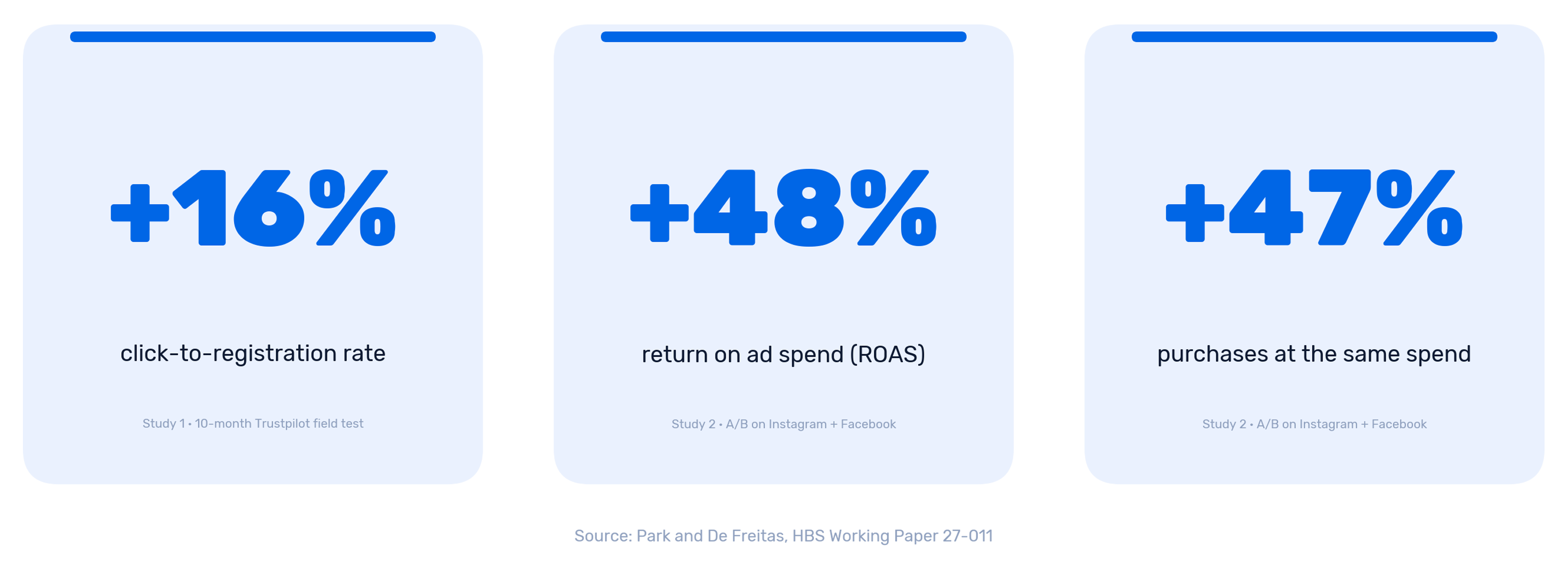
Study at a glance: In two large-scale field experiments run on real brand budgets, activating automated comment moderation raised click-to-registration rate by 16% and return on ad spend by 48%, with every other campaign variable held constant. Four preregistered lab experiments (N = 4,873) confirm the effect and identify perceived brand trust as the mechanism. |
Why do brands ignore ad comment moderation?
Two beliefs make this blind spot rational.
First, ad platforms sell optimization above the fold. Creative testing, audience iteration, bid strategy, and placement are the levers you own inside the ad manager. Comments live in a separate workflow: community management, customer care, sometimes PR. Nothing in the paid social workflow asks you to look there. Even major platforms have scaled back their own moderation investment.
Second, common intuition says harmful comments are noise, not signal. A troll under an ad feels obviously fake to the marketer who put the ad live. It is easy to assume the buyer sees it the same way and scrolls past. If the noise is filtered by the brain, the reasoning goes, it cannot really move the buying decision.
Both beliefs are defensible in the absence of causal evidence. The new Harvard paper supplies the evidence.
What the research actually found
1. In a real-money field test, activating comment moderation raised conversion by 16% at the same spend.
Study 1 tracked a financial-services brand running a Trustpilot ad continuously for 10 months. For the first 5 months, comments were unmoderated. In month 6, an automated moderation and engagement solution (BrandBastion's) was turned on, with everything else about the campaign, including targeting, creative, and budget, held constant. Registration completion rate per click rose from 1.67% (control) to 1.94% (treatment), a statistically significant 16% relative lift across roughly 3.4 million link clicks (X²(1) = 333.76, p < .001). The total count of completed registrations rose 43.6% over the same window. No creative or bid change caused it.
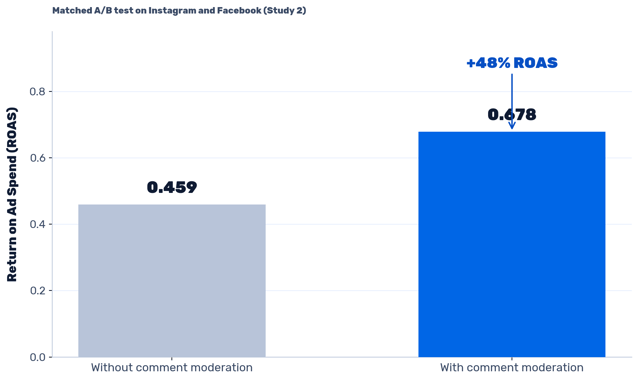
2. In a matched A/B split across Instagram and Facebook, moderated campaigns produced 48% more return on ad spend than unmoderated identical campaigns.
Study 2 ran two identical pairs of campaigns across Instagram and Facebook for one month for an online personal-growth brand Mindvalley, using a matched A/B design that held targeting, creative, budget, and time constant. The only difference between arms was whether automated comment moderation and engagement was on. The moderated arm produced ROAS of 0.678 versus 0.459 in the control, a 48% relative improvement, with 22 purchases versus 15, and a cost per purchase of $454.34 versus $666.56. Same ads. Same audience. Same money. Different comment section.
3. When the researchers isolated which part of comment management drove the lift, moderation was the mover, not engagement.
Study 3 (N = 398) and its conservative replication (N = 2,485) crossed brand engagement (present versus absent) with harmful comment moderation (present versus absent). Purchase intent moved on moderation (M = 47.2 with moderation versus 36.9 without in Study 3, replicated at M = 46.9 versus 34.1 in the larger sample, all p < .001). Brand replies to positive comments did not move intent on their own. Whether the brand chatted friendly under the ad mattered far less than whether the harmful content was still visible.
4. Brand trust is what actually moves, and hiding harmful comments works precisely because it protects it.
Across the follow-up studies, moderation lifts purchase intent by lifting perceived trust in the advertising brand. To explain why, the authors reach for the classic broken-windows theory from urban sociology (Wilson and Kelling, 1982): a single broken window left unfixed signals that no one is watching the block, which invites more damage over time. The neighborhood degrades not because the window itself matters, but because of what the unfixed window tells everyone about who is responsible for the space.
The comment section under a paid ad works the same way. A visible harmful comment is the broken window; the brand is the landlord. A shopper does not consciously catalog the toxic comment, but they register the signal: no one is minding this brand's storefront. The trust penalty is not about the comment. It is about the brand that let it sit there.
Which platforms does this hold on?
The direct evidence spans the surfaces most brands actually buy paid social on. Study 1 ran on Trustpilot, Study 2 ran across Facebook and Instagram, and the lab studies used interfaces modeled on Instagram and X. TikTok and LinkedIn were not tested directly, but the paper positions them on the same platform-transparency spectrum the tested platforms sit on, which is enough to reason about how the effect should apply on each.
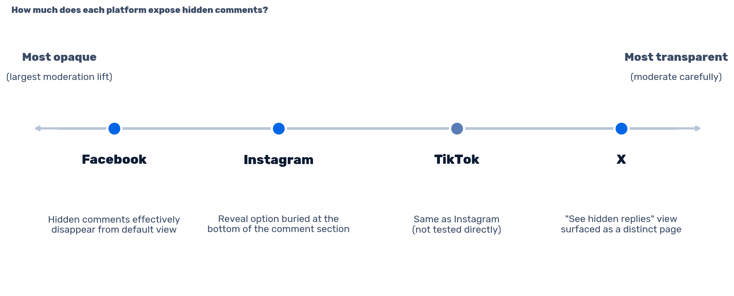
The important platform-specific detail is how visible each platform makes the fact that comments have been hidden. Among the majors, X sits at one end of the spectrum: users can open a labeled "See hidden replies" view and read the hidden comments directly. Instagram and TikTok support the same reveal, but bury the option at the bottom of the comment section, so most users never encounter it. Facebook sits at the other end: hidden comments effectively disappear unless someone manually flips the sort order from "Most relevant" to "All comments."
The moderation lift is largest and cleanest on the more opaque surfaces. Facebook is where the tested effect held with the fewest caveats. Instagram tested with the same result. TikTok was not tested directly, but sits in the same opacity band as Instagram, so the same logic should apply. On X, moderate universally harmful content without hesitation, and be more selective about hiding brand-directed criticism, since users can find it in the transparent view and read your moderation as self-defense.
LinkedIn is a different case: brands cannot hide comments on paid posts, only delete. The Harvard research does not test LinkedIn directly, but the underlying mechanism (harmful comments erode brand trust, brand trust drives ad conversion) is not platform-specific. Practical read on LinkedIn: keep the ad's comment surface clean using the tools available, and disclose your community policy on your company profile if you want the extra brand-trust lift the research also found.
When does hiding harmful comments backfire?
The research identifies two governance conditions that decide the size and direction of the effect.
Whether the platform exposes the hidden comments matters, but only for attacks aimed at the brand. When a platform lets shoppers surface the comments a brand has chosen to hide, and those hidden comments are attacks on the brand itself, the effect flips. Study 4A shows a clean reversal: purchase intent was 37.5 with moderation on, and 45.2 with moderation off, once participants could see that criticism of the brand had been hidden. Once the audience can see the brand is quieting its critics, moderation reads as a brand looking out for itself, and trust drops. When the hidden comments are broadly offensive to anyone (profanity, hostility unrelated to the brand), the lift from moderation holds even under a transparent platform (Study 4B). Practical read: the cleanest, largest gains come on platforms that do not put a surface on hidden comments. On platforms that do, be careful about which comments you moderate.
Brand transparency about the policy, coming from the brand itself, does not undermine the effect. In Study 5, brands that pinned a plain "we hide comments that violate community guidelines" note to their social profile kept the full lift from moderation, and even gained a small brand-trust bonus. Voluntary disclosure by the brand reads very differently from third-party exposure by the platform.
The new rule: treat the comment section as part of the ad
Treat your ad's comment section as part of the ad. If harmful comments are visible under a paid post, the campaign is running with a broken window. Moderate universally harmful content aggressively and reliably across every platform; be more selective about hiding brand-directed criticism on the platforms that surface hidden replies most transparently; disclose your policy on your own profile if you want the extra trust lift. Each of these is under the brand's direct control. None of them requires a new creative test, a new audience, or additional media spend.
Run the test on one of your own campaigns this quarter
Take one paid campaign that has been running for at least 30 days, in a category with lively comment activity. Pull the last 30 days of comment volume and conversion rate. Turn on always-on moderation for the next 30 days. Hold every other campaign variable constant. Compare conversion rate per click and cost per purchase across the two windows.
If running 24/7 moderation across every ad, in every language, is not realistic for your team, BrandBastion can run this test with your brand. We offer brand-specific moderation at scale in 194 languages, so you can measure the effect inside your ad account while keeping the same 30-day structure. Book a meeting to see how we can handle moderation on paid social.